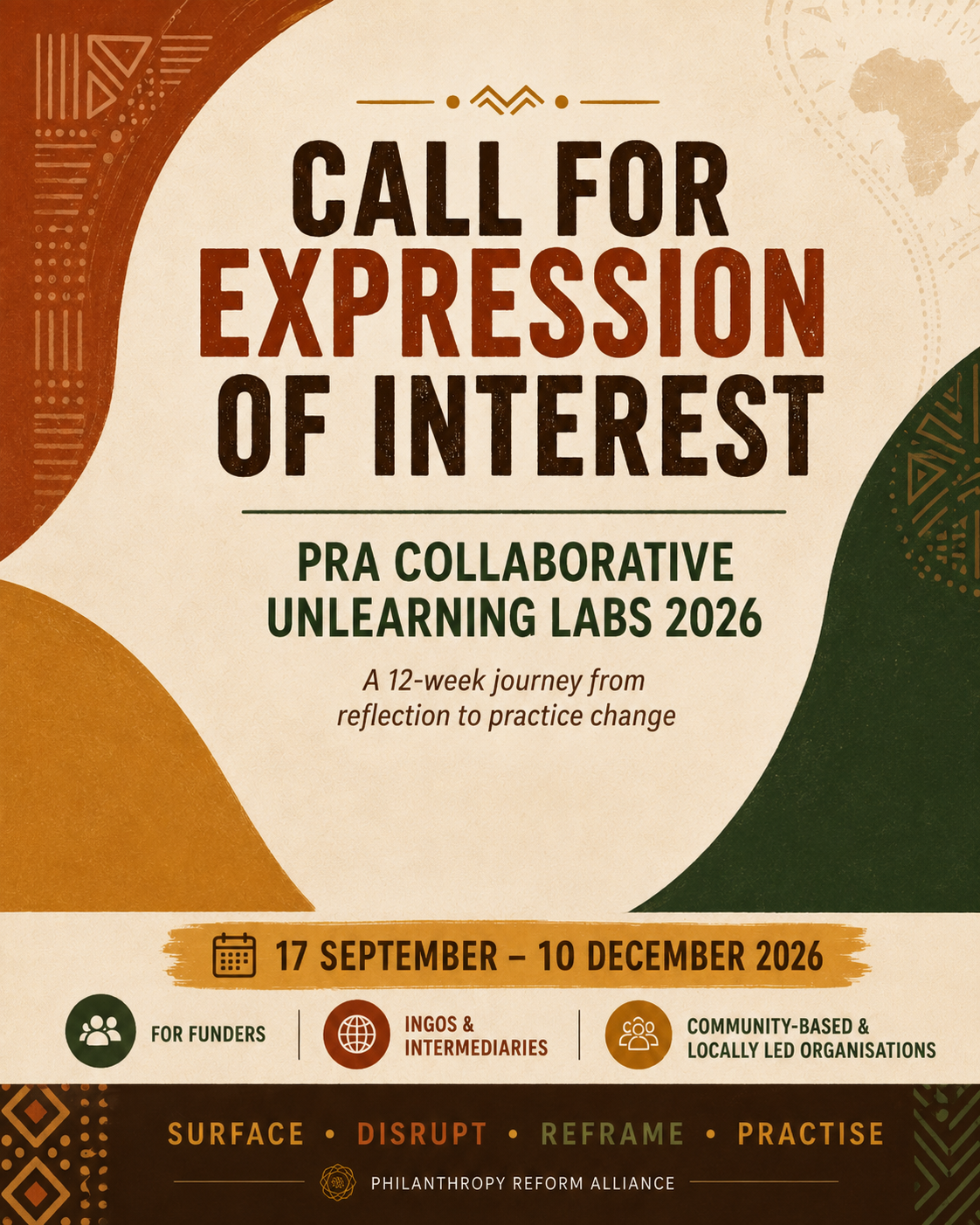
CUL Cycle 2 prospectus
August 6, 2026
COLLABORATIVE UNLEARNING LABS
Programme Prospectus (Cycle 2)
A Practice Change Journey for Philanthropy and Development Practitioners
Every development system carries a history. The partnerships we build, the institutions we strengthen, the evidence we privilege, the risks we manage, and even the language we use are shaped by assumptions inherited over generations. Some of these assumptions have enabled progress. Others continue to reproduce unequal relationships, concentrate decision-making, and distance development from the communities it seeks to serve.
Collaborative Unlearning begins with a simple proposition:
If we are serious about transforming development, we must also be willing to examine the colonial legacies, institutional habits, and inherited beliefs that continue to shape how we think, partner, fund, and lead.
Because systems do not change on their own. People do.
WHY THIS JOURNEY
Across philanthropy and development, there is growing consensus that power must shift, communities must lead, and partnerships must become more equitable. Yet many of the systems we work within continue to be shaped by colonial logics — ideas about expertise, authority, legitimacy, partnership, and whose knowledge counts. These logics are rarely questioned, because they have become normalised through institutions, funding relationships, professional cultures, and everyday practice. The result is a persistent gap between what we say we value and how we actually work.
We cannot build decolonised futures using assumptions we have never examined.
This programme is an invitation to do that work together — not through blame, but through collective reflection, courageous dialogue, and practical institutional change.
WHAT IS COLLABORATIVE UNLEARNING
Collaborative Unlearning is PRA's decolonial practice methodology: the intentional practice of examining and letting go of inherited assumptions, behaviours, institutional habits, and relationships that continue to reproduce unequal power, even when our intentions are good. It is grounded in the belief that systems change begins by transforming how people think, relate, decide, and act.
Together, participants examine how colonial legacies continue to influence:
Who decides How problems are defined, who sets priorities, and who controls resources. | What counts What counts as evidence, and whose expertise is recognised. | How we relate How partnerships are structured, accountability is designed, and who is trusted to lead. |
The purpose is not simply to critique but to imagine and practise alternatives rooted in solidarity, reciprocity, trust, shared stewardship, and local agency.
THREE PATHWAYS, ONE JOURNEY
Collaborative Unlearning meets each actor in the system where their power actually sits. Participants join one of three pathways, each confronting a distinct form of inherited authority.
FUNDERS & PHILANTHROPIC LEADERS From Philanthropic Authority to Solidarity Stewardship This journey explores how colonial histories continue to shape philanthropy through agenda-setting, risk, authority, and definitions of impact. Participants examine what becomes possible when philanthropy moves beyond generosity toward stewardship, redistribution, and shared decision-making. |
INGOS & INTERMEDIARIES From Gatekeeping to Solidarity Accompaniment This journey examines how intermediary organisations can unintentionally reproduce colonial relationships through control of funding, expertise, visibility, and access. Participants explore how to redesign intermediation around accompaniment, reciprocity, and the intentional transfer of authority. |
COMMUNITY-BASED ORGANISATIONS From Survival to Community Agency This journey recognises that coloniality is also internalised. It creates space for community organisations to examine donor dependency, mission drift, and internal power, while reclaiming local knowledge, political agency, and community-rooted leadership. |
PROGRAMME AT A GLANCE
Cycle 2 is delivered as a modular, cohort-based learning journey. Each pathway moves through its own sequence of facilitated sessions, paired with cross-pathway moments where funders, intermediaries, and community organisations reflect and unlearn together.
Pathway-Specific Modules Facilitated sessions grounded in the realities of each actor's position in the system. | Cross-Pathway Dialogue Shared sessions where funders, intermediaries, and CBOs unlearn in the same room. | Reflection & Practice Guided reflection tools and commitments to concrete institutional change. |
WHAT PARTICIPANTS LEAVE WITH
— A clearer, more honest picture of how their institution's practices reproduce or disrupt colonial patterns.
— A shared language for naming power, authority, and legitimacy across a partnership.
— Practical commitments carried back into institutional decisions.
— A cohort of peers across the funding chain who are unlearning the same assumptions together.
Join Cycle 2
Collaborative Unlearning Labs cycle 2 is open to funders and philanthropic leaders, INGOs and intermediary staff, and community-based organisations ready to examine how their own institutions practise development — and to change it.
Register your interest - https://forms.gle/UgRct4tHgKF5vnn78