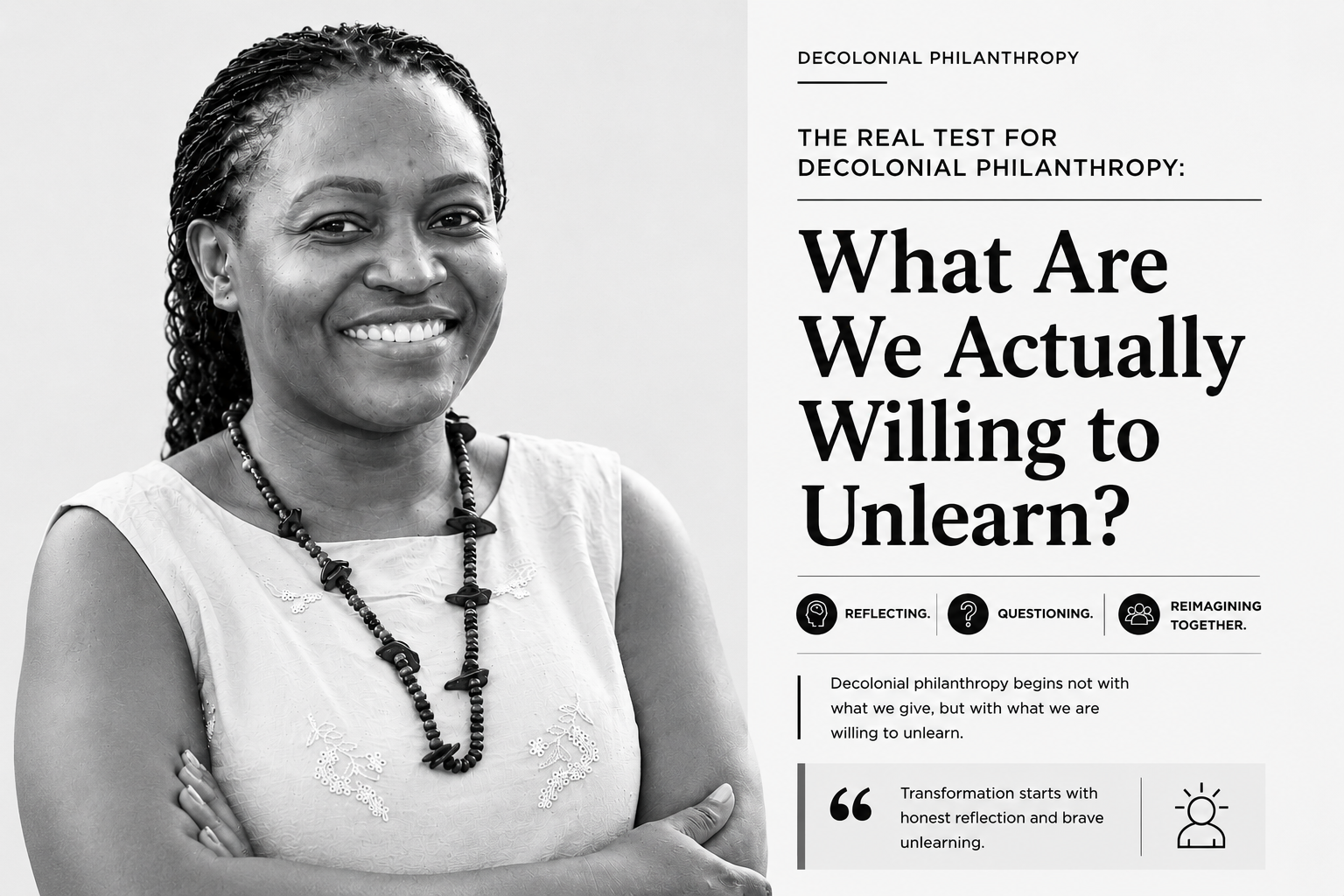
The real test for decolonial philanthropy: What are we actually willing to unlearn?
August 16, 2026
There is something interesting happening in philanthropy and development right now. We have become much more comfortable talking about power, localisation, trust, equity and decolonisation, and words that would have been considered uncomfortable or even confrontational a few years ago now appear regularly in strategies, funding guidelines, conference programmes and organisational statements. This is important progress, but it has also left me wondering about the distance between the language we have learned to use and the practices we are actually prepared to change. After spending the last several months creating spaces where practitioners could sit with some of these questions through the Philanthropy Reform Alliance’s Collaborative Unlearning Labs, I have become increasingly interested in a question that feels much harder than simply asking whether philanthropy is ready to talk about decolonisation: what happens after we agree that the system needs to change?
The Collaborative Unlearning Labs were created around a fairly simple premise: that some of the most persistent problems in development and philanthropy cannot be solved simply by introducing another framework, policy or technical solution, because they are also sustained by assumptions, relationships, institutional incentives and ways of exercising power that have become so normalised that we often stop seeing them. Our pilot brought together practitioners from 57 countries and 92 organisations to explore questions of power, partnership, localisation, trust and institutional change, and the level of interest confirmed that there is a real appetite for spaces where practitioners can move beyond the familiar language of reform and examine what actually sits underneath everyday practice.
But the pilot also taught us something else, and perhaps this is the more important lesson: interest alone is not transformation. People can be deeply interested in questions of power and still struggle to change the practices through which power operates. They can leave a conversation convinced that something needs to be different and return the next morning to an organisation whose policies, funding structures, reporting requirements, risk systems and incentives continue to reward the very behaviours they have just spent two hours questioning.
That tension has stayed with me.
We have learned the language. Have we changed the architecture?
There is now a growing sophistication in the language of philanthropic reform. A funder can say that they believe in locally led development, an organisation can say that it values community knowledge, and a foundation can publicly commit to shifting power, while the actual experience of a partnership may remain remarkably familiar: the funder defines the funding priorities, establishes the parameters, decides what constitutes acceptable risk, determines the reporting requirements and ultimately retains significant influence over how success is understood.
This is not necessarily because anyone in the relationship has deliberately set out to reproduce inequality. In fact, one of the things that became clear through our unlearning conversations is that many of these patterns are sustained by ordinary institutional behaviours carried out by people who may themselves be committed to doing good. A programme officer follows the organisational risk framework; a grants manager requests another report because that is what the institution requires; a funder establishes a three-year outcome framework because the organisation needs measurable results; an intermediary passes donor requirements down to a local organisation because those requirements have been passed down to them. Each decision can appear reasonable when considered in isolation, yet collectively they can create a system in which one side defines the problem, controls the resources and determines the terms under which accountability is exercised.
This is what we were trying to make visible in one of our pilot sessions, which we called “The Invisible Architecture of Decision-Making.” The conversation explored how funding systems, institutional norms, professional hierarchies and knowledge systems influence whose voices are prioritised, whose expertise is recognised and who ultimately has the authority to make decisions.
The architecture is invisible precisely because much of it has become normal. And perhaps that is why changing a strategy document is easier than changing a relationship.
The uncomfortable space between intention and practice
One of the ideas that shaped our first session, Unlearning Colonial Ways of Doing Good, was the distinction between good intentions and transformative action. It is a distinction I have found increasingly important because conversations about decolonisation can sometimes become overly focused on identifying the wrong way of doing things, as though the problem can be solved by identifying who is reproducing colonial practice and who is not. The reality is considerably more complicated.
Most people working in philanthropy and development do not wake up intending to reproduce unequal systems. They may genuinely care about the communities they work with, genuinely believe in partnership and genuinely want to contribute to positive change. Yet good intentions can coexist with practices that concentrate power, because systems do not require bad intentions in order to reproduce themselves. They require habits, incentives and assumptions that are rarely examined because they are embedded in the way institutions function.
This is why the question of decolonisation has to move beyond intention. It is not enough to ask whether we mean well. We have to ask what our way of working actually produces.
If we say that local knowledge matters, where does that knowledge enter the decision-making process?
If we say that communities should lead, what decisions are they actually able to make?
If we say that we trust our partners, what happens when they make a decision we would not have made?
If we say that risk should be shared, whose organisation carries the consequences when something goes wrong?
These questions are more difficult because they take us away from the comfort of values and into the messiness of practice.
Unlearning is not comfortable
Perhaps we should also be more honest about what we are asking people to do when we invite them to unlearn.
Unlearning is not simply learning a new set of concepts and adding them to an existing professional toolkit. It can mean questioning things that are deeply connected to how we understand ourselves and our competence. It may require someone who has spent years being recognised as an expert to ask whether the expertise they have been rewarded for is the only expertise that should shape a decision. It may require a funder to consider whether a risk framework designed to protect the institution is, in practice, transferring risk to the organisation receiving the grant. It may require someone to look at a partnership they have always described as equitable and ask whether it feels equitable to the person sitting on the other side of the relationship.
Those questions can be uncomfortable because they are not purely intellectual. They touch professional identity, institutional reputation, resources and relationships.
Our pilot showed us that conversations about coloniality, saviourism, institutional power, exclusion and unequal partnerships can generate defensiveness, discomfort and vulnerability. We therefore learned that a courageous learning space cannot simply be a space where people are challenged; it has to be a space where challenge is held alongside care, where accountability can exist alongside curiosity, and where people can encounter difficult truths without being pushed into silence or defensiveness.
That balance is important because if unlearning becomes another form of public punishment, people will simply become better at protecting themselves. They will learn the right language, say the right things and return to the same practices.
And that would be a very sophisticated form of not changing.
The people in the room do not hold equal power
Another lesson from the pilot has stayed with me because it challenges one of the assumptions we often make about participation: that putting people in the same room creates an equal opportunity for everyone to speak.
It does not.
A funder, an INGO representative, an intermediary and a community-based organisation may all be invited into the same conversation, but they do not necessarily have the same freedom to speak. One person's disagreement may be interpreted as a thoughtful contribution; another person's disagreement may have implications for whether their organisation is funded, invited back into the room or considered a difficult partner.
Our report puts this quite plainly:
“participants do not enter the room with equal power.”
This has implications for how we think about participation in philanthropy. Inviting someone into a meeting is not necessarily sharing power with them. Listening to someone is not necessarily giving them influence. Calling an organisation a partner does not automatically make the relationship a partnership, and consulting communities does not necessarily mean that communities have participated in the decision.
The more difficult question is what happens to people's contributions once they enter the room. Do their perspectives change the decision? Do they change the allocation of resources? Do they alter how the problem is understood? Do they change the institution itself?
A decolonial approach therefore asks us to move beyond representation and examine influence.
From conversation to practice
The pilot was deliberately experimental, and one of the most useful things it did was show us where conversation stops being enough. We found that our sessions could successfully surface difficult questions about power, trust, partnership and decision-making, but without a stronger practice component, participants could leave with greater awareness while returning to organisations whose systems and procedures had not changed.
That creates a difficult gap between personal insight and institutional change.
In response, we redesigned the Collaborative Unlearning Journey around four stages: Surface, Disrupt, Reframe and Practise. The intention is to help participants first make visible the assumptions and invisible systems shaping their work, then question the behaviours and beliefs that reproduce unequal relationships, imagine different possibilities grounded in trust, reciprocity and local agency, and finally experiment with those possibilities in their own contexts.
That final movement from reflection into practice is perhaps the most important.
Unlearning should eventually become visible in the way a funder makes decisions, in who participates in setting priorities, in how risk is understood, in how flexible funding can be, in whether local organisations can influence the agenda, in how feedback moves through a relationship and in what happens when a community says, “This is not working.”
For this reason, the redesigned model does not simply ask whether participants enjoyed the learning experience or whether their understanding changed. We are interested in whether participants experiment with different behaviours, whether partnership conversations change, whether decision-making processes shift, whether policies and procedures are reviewed, whether funding becomes more flexible or locally governed, and whether accountability and resource allocation change as a result.
The objective is not to complete an unlearning course. It is, as our report puts it, to change how participants “relate, decide, fund, lead, communicate, and exercise power.”
Perhaps philanthropy needs to unlearn its need for certainty
There is another tension I keep returning to, particularly when thinking about what a genuinely different philanthropic practice might require.
Philanthropy is often built around certainty. We want the theory of change, the indicators, the milestones, the risk assessment, the reporting framework and the evidence that demonstrates that the investment is working. Accountability matters, and communities have every right to expect resources to be used responsibly. But I wonder whether our pursuit of certainty sometimes creates a different problem: we design funding relationships around what institutions can predict and control rather than around what communities need to navigate complex and changing realities.
What would happen if some of our understanding of good stewardship included the capacity to learn alongside the people we are funding?
What if trust did not mean believing that a partner will always make the decision we would have made, but being willing to remain in relationship when they make a different decision?
What if accountability were not primarily about requiring communities to explain themselves upwards, but also required institutions holding resources to remain accountable for the conditions they create?
These are not arguments for abandoning rigour. They are arguments for asking where rigour sits and whom it serves.
Rigour should not only be about proving that a grantee followed the plan. It should also be about examining whether the relationship itself creates the conditions for dignity, agency, learning and shared accountability.
From grantmaking to solidarity stewardship
This is the thinking behind the funder pathway we are now developing within the Collaborative Unlearning Labs: From Grantmaking to Solidarity Stewardship.
We are interested in what happens when philanthropy is understood not simply as the distribution of resources, but as the stewardship of resources, relationships and power. Solidarity stewardship does not mean that funders disappear, that accountability disappears or that local organisations are romanticised as though communities are somehow free from complexity or internal power dynamics. It means becoming much more intentional about the relationship between resources and agency, and about the responsibility that comes with holding institutional power.
The shift is subtle but significant. Instead of asking only, “How can we make our grantmaking better?”, we might begin asking, “What kind of relationship with resources, power and people are we trying to create?”
That question opens up a different conversation.
It asks whether resources are being stewarded with people rather than simply for them. It asks whether local actors are recognised not simply as implementers or recipients, but as knowledge holders, decision-makers and leaders of change. And it asks whether funders themselves are willing to be changed by the relationships they enter into.
We cannot unlearn alone
One of the most important lessons from our pilot is that unlearning is not a destination.
It is not something a person completes after reading the right books, attending the right workshop or learning to use the right terminology. It is an ongoing practice of questioning, experimentation and reflection, and it requires enough time and continuity for people to encounter perspectives different from their own, return to their own practice, try something different and then come back and examine what happened. Our pilot showed us that one-hour conversations could open the door, but meaningful change requires a journey built around trust, continuity, practice and accountability.
That is where I see the real opportunity for African philanthropy.
We do not need another perfect model.
We do not need to replace one orthodoxy with another.
And we certainly do not need another set of polished statements about shifting power that never reach the places where decisions are actually made.
What we need are spaces where people can be honest enough to ask what they are still carrying, what they are protecting, what they are willing to let go of, and what might become possible if philanthropy changed not only what it funds, but how it relates, decides and shares power.
The conclusion of our Collaborative Unlearning Labs report says this more clearly than I could:
“Unlearning is not completed when a difficult truth is recognised. It begins when that recognition changes how people relate, decide, lead, share resources, and practise solidarity.”
That is the real test for decolonial philanthropy.
Not whether we have learned to use the language.
Not whether our strategies contain the right commitments.
But whether the language has changed what we actually do.
Because ultimately, decolonisation cannot remain an idea that philanthropy talks about.
It has to become something philanthropy is willing to practise, experience and be changed by.